

FAQs
Frequently Asked Questions
Have a question about Carson Stadium? Your answer may be below.
As we get closer to opening day, more answers and information — including parking, accessibility and other topics — will be added.
Stadium Planning & Timeline
Where will the stadium be located?
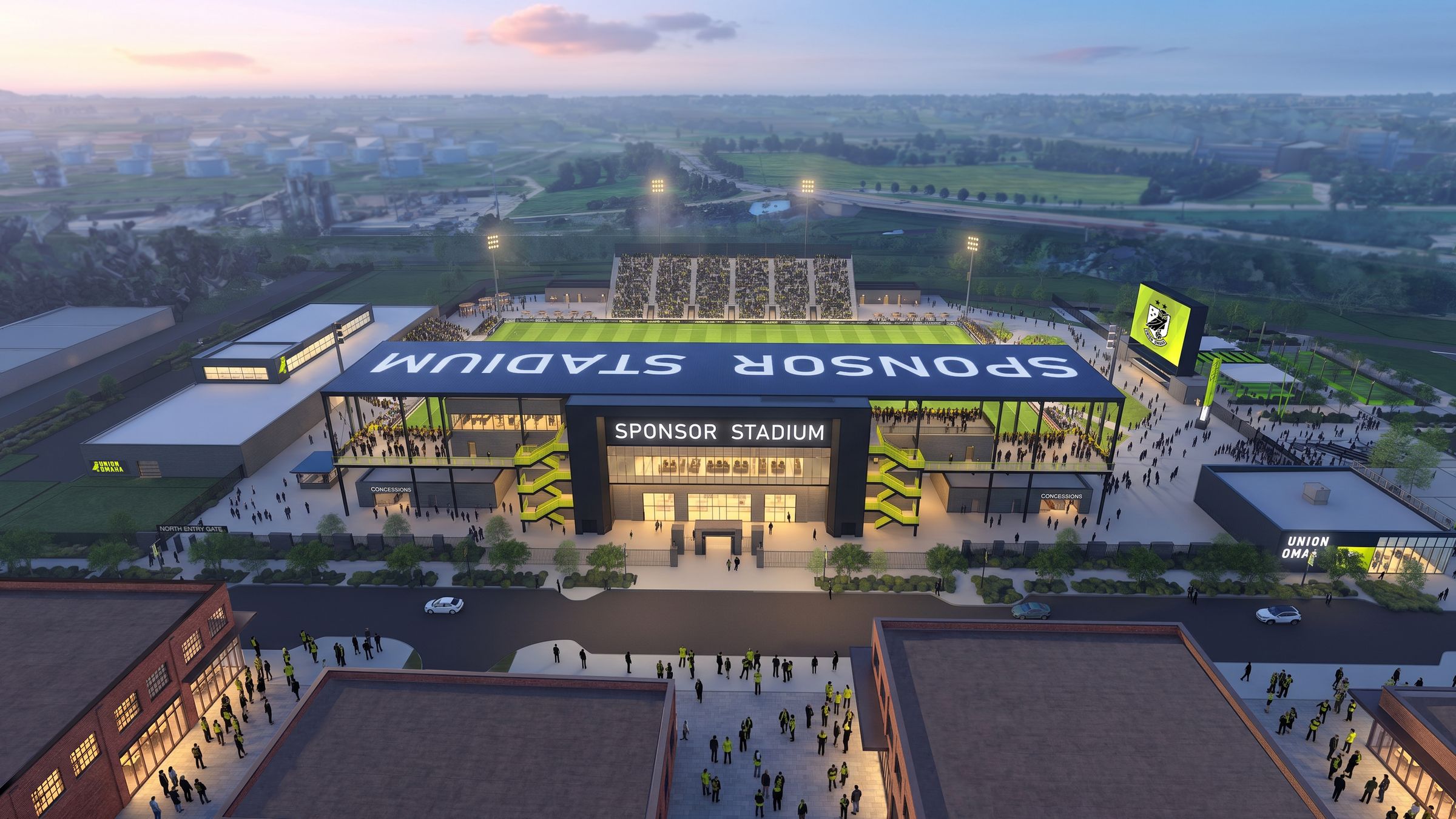
The project will rise on a largely unused site at 10th and Izard Streets, located north of Cuming Street, roughly across the street from Charles Schwab Field. The tract of land is east of the Millwork Commons and Future Forward areas. When complete, the stadium will serve as a visual gateway to Omaha, helping to create a walkable, vibrant and transit-oriented destination. Drone footage of the area and a rendering of the stadium are available here. The City of Omaha acquired this site in June 2026.
What is the general timeline to build the stadium?
- 2028: Targeted opening of Carson Stadium
- To be confirmed: Construction schedule to be confirmed
- January 11, 2027: Public deposits open
- December 2, 2026: Deposit program announcement
- Late Fall 2026 (target): Targeted groundbreaking
- November 30, 2026 (completed): Carson Stadium naming announced with Carson Wealth as naming rights partner (read the announcement)
- October 27, 2026 (completed): City Council approves the redevelopment agreement and stadium lease
- June 2026: City purchase of the land
- May 2026: State of Nebraska approves the sales tax turnback incentive
- April 2026: Unanimous City Council approval of the redevelopment plan and financing tools
- November 2025: Union Omaha and the City of Omaha announce plans for a new downtown stadium and mixed-use district
How large will the stadium be?
The stadium will include approximately 6,500 fixed seats, with overall capacity reaching about 8,500 with the berm and standing-room spaces. It will also hold about 8,500 to 9,000 for concerts and similar events.
What is the local economic impact of the stadium?
In the construction of the stadium, an estimated 200 jobs will be created. The construction will also create approximately $27 million in direct spending and $57 million in total output into the local economy. Between construction and operation impacts, approximately $430 million will be generated in total output locally.
Who is building Carson Stadium?
The stadium will be built through a public-private partnership between the City of Omaha and Union Omaha, with Hines acting as development manager. Because the City will own the stadium, construction is proceeding through a public procurement process.
The City has issued a competitive request for proposals to select a Construction Manager at Risk (CMAR), who will work with the project team during pre-construction and oversee construction of the stadium. The CMAR will also manage competitive bidding for the many trade contractors needed to complete the project, including electrical, plumbing, drywall and other specialized work. This process provides transparency and competitive bidding throughout construction.
What are the estimated costs to build the stadium?
Total cost to build the stadium is estimated at about $140 million. This includes all hard and soft costs associated with the stadium. Through this public-private partnership, Omaha gains a major public asset, owned by the City, and paid for largely by the new revenue the project creates, made possible through the efficient use of proven economic development and financing tools.
What other events or activities will occur in the stadium?
The stadium will create a premier venue in the heart of Omaha for events year-round. Along with soccer matches, Union Omaha will host nonprofit events, concerts, corporate outings and more, working with community partners to integrate into community events. Union Omaha is also committed to community impact by hosting youth tournaments, school championships and learning opportunities that connect young people to the excitement of the game and inspire the next generation of players and fans.
What is the plan for parking?
Union Omaha is working with the City of Omaha and adjacent developments on parking. The parking strategy is to utilize existing resources to the greatest extent possible to avoid the cost and land use of building more parking in the urban core.
What types of housing and mixed-use opportunities will there be?
The location offers ample space for a modern stadium plus new housing, entertainment, retail and public areas. The result will be a vibrant destination that adds energy and purpose to the city’s urban core. The overall district is expected to be an approximately $330 million investment, the majority of which will be paid for privately.
How does the stadium connect with Millwork Commons, Future Forward, MECA and other development in the area?
The stadium is part of a much larger transformation underway in this area of downtown Omaha. It will help connect Millwork Commons, MECA and the CHI Health Center Omaha, and Future Forward with potentially 1,000 new housing units planned north of Cuming Street, along with new hospitality, restaurant, retail and other development. Together, these investments will create a new, active district that brings more people downtown to live, work, visit and gather.
Financing Tools
Is existing taxpayer money being used?
The only new public expenditure is for the stadium land and public infrastructure. The site currently has no roads, sidewalks, sewer or water. Beyond these public investments, no taxpayer money is spent because the project pays for the project through new revenues:
- New property value and property tax revenues
- New sales activity and sales tax revenues
- New economic development
“But for” the project, these revenues do not exist. Thus, the project pays for the project.
How is the stadium being financed?
In addition to private investment, the project uses six financing tools that work together. The key idea is simple: they rely on new revenue created by the development, not existing taxpayer dollars.
1) Developer Equity. Union Omaha has spent approximately $6,000,000 developing the stadium project to date. Union Omaha is legally committed to providing $23,000,000 in “equity” toward the cost of stadium construction.
2) Stadium Lease. The team will pay the City an annual lease payment, which the City will use to help pay the construction bonds.
3) Tax Increment Financing (TIF). TIF uses the increase in property taxes created by new development. The project still pays full property taxes, but the new taxes paid by the project on new valuation the project creates helps fund eligible improvements and construction bonds. After 20 years, all new property taxes will go to the taxing entities such as the Omaha Public School District and the City.
4) Occupation Tax (Enhanced Employment Area). This is a small, additional sales tax applied only within the district. These revenues go to pay off construction bonds. The existing sales tax still goes to the City and state as before. The additional tax is new revenue generated by the project itself and helps support development costs.
5) State Turnback Tax. This allows 70 percent of new state sales tax generated near the stadium, up to $1.25 million per year for 20 years, to be used to help pay for stadium construction by going directly to bond debt payments. It applies only to a limited area around the stadium, which currently generates almost no sales tax — this is all new revenue. The state still receives 30 percent of all new sales taxes in the area immediately and receives all of it after 20 years. The State of Nebraska approved this incentive in May 2026.
6) City Financing (Lower Borrowing Costs). The City can borrow at lower rates than private developers. This reduces overall costs and helps make the project feasible. The City will issue lease purchase bonds, which the above revenues will pay off. The City will own the stadium, which ensures long-term control and viability, while the vast majority of the debt service will be paid for by Union Omaha and private developers.
Why did the City buy the land, and why will it own the stadium?
This is a key part of the structure and a major benefit to the public.
- The City bought the land in June 2026. The City will own the stadium and the land beneath it, giving it long-term control.
- The developer will purchase the surrounding mixed-use land from the City, offsetting the City’s cost for the stadium land.
- The project makes ongoing lease payments to the City, meaning the team ultimately pays for the stadium the City owns.
- Revenue generated by the project pays the debt incurred to build the stadium.
Why does this public-private partnership approach make sense for Omaha?
This structure is designed to do four things at once:
- Turn underutilized land into a productive, tax-generating district
- Create a long-term public asset owned by the City
- Use new economic activity to help pay for the investment
- Protect taxpayers from financial contribution and risk
How is the City protected financially?
The agreement includes multiple safeguards:
- Developer equity: the team, as developer of the stadium, will contribute approximately 15 percent of the cost of the stadium as equity, even though the City will own the stadium and the team will pay an annual lease payment.
- Project-generated revenues (TIF and state turnback funds) are directed toward stadium costs.
- The team will make annual lease payments.
- Additional revenue sources, like naming rights, parking and event income, also help pay for the stadium, serve as a backstop to debt shortfalls and provide a source for future capital improvements.
- The project must meet key milestones as major public investment is made.
- As the owner of the stadium and “landlord,” the City retains oversight and control and has a valuable public asset.
This structure is designed so the project — not existing taxpayers — carries the financial load and risk. It’s a model that allows the city to grow while limiting risk.
Tickets & Deposits
When will tickets be available for Carson Stadium?
Union Omaha will begin accepting 2028 season ticket deposits for Carson Stadium on January 11. Deposits establish your priority to select available season tickets, with additional information about seating, pricing and timing to come as plans are finalized. Get deposit updates.
Why should I place a 2028 season ticket deposit today?
A deposit establishes your priority to select available 2028 season tickets at Carson Stadium. Within the season ticket holder and public deposit tiers, selection order is based on deposit timestamp. A deposit does not guarantee a seat, section, category or price.
Is my 2028 season ticket deposit refundable?
Deposits are nonrefundable except if the stadium project is canceled, Union Omaha does not play its 2028 home season at the stadium, or your recorded seating category is sold out when your turn arrives under the published priority rules. In those cases, you are entitled to a full refund. If your category is sold out, you may choose a refund or apply your deposit to another available category. A refund forfeits your place in the deposit order.
What are the 2028 season ticket prices?
Final pricing is not yet confirmed. The plan is to release 2028 season ticket prices 30–60 days before ticket purchases begin.
Do 2027 season ticket members need to place a 2028 deposit?
No, 2027 season ticket members do not need to place a deposit. 2027 season ticket holders will have priority over 2028 deposit holders. If you would like to purchase a 2027 season ticket membership, visit the Union Omaha website.
What is the cost of a 2028 season ticket deposit?
$25 per account for the Supporters Section, $50 for Reserved Seating, and $100 for Premium Seating. All deposits go towards final purchase.
How many 2028 deposits do I need to purchase?
The planned program uses deposits per account, with each deposit account eligible to purchase up to eight season tickets, subject to availability.
Do I have to submit a deposit to buy 2028 season tickets?
A deposit is required to participate in priority seat selection, including for 2027 season ticket holders. General public sales without a deposit are targeted for after the 2027 season and deposit holder selection.
When do I select my 2028 seating location?
Seat selection will take place in scheduled groups according to the published priority rules. Deposits establish selection priority but do not guarantee a specific seat, section, category or price.
How many season tickets will I be able to purchase if I put down a 2028 deposit?
Each deposit account (not including suite deposits) may purchase up to eight season tickets, subject to availability.
Is there anyone I can contact if I have other questions about placing a 2028 deposit?
Yes, call (402) 884-8053 or email [email protected] if you have additional questions about placing a 2028 deposit.
About Union Omaha & USL League One
As the stadium is constructed, where will Union Omaha play?
Union Omaha, led by sporting director Jamie Henderson and head coach Vincenzo “Vinnie” Candela, has an agreement to play the 2026 and 2027 seasons at Creighton University’s Morrison Stadium. Season tickets are currently available here.
What is the history of USL League One, where Union Omaha plays?
Union Omaha plays in USL League One, the United States Soccer Federation-sanctioned Division III league. Launched in the spring of 2017, League One’s goal is to continue to grow the game of soccer in America by offering new communities the opportunity to support local soccer clubs and providing pathways for youth players to follow their professional dreams.
Tell me about Union Omaha.
Since launching in 2020, Nebraska’s premier professional soccer team has established itself as one of the most successful clubs in American professional soccer. The Owls have won two USL League One championships, consistently competed at the top of the league and defeated teams from higher divisions. In 2026 the Owls set the league record for the longest home unbeaten streak, extending it to more than 25 consecutive league matches.
Beyond its success on the field, the club is inspiring more Nebraska youth to explore soccer and strengthening the sport’s future across the region. To build on this success, Union Omaha is developing a soccer-specific stadium in downtown Omaha, establishing a permanent home for the club and positioning it for its next chapter of growth.
Will the stadium also host a women’s soccer club?
Yes. We are excited for the potential to bring women’s soccer to Omaha, but the stadium has to be built first.
How can the community and businesses get involved and support Union Omaha?
Union Omaha is looking for individuals and organizations interested in participating in focus groups, exploring partnerships and helping us identify ways to activate the stadium and make it a community asset. To get involved, contact us at [email protected] or visit our Partnerships page.